Centering lived experience in the study of food justice
DOI:
https://doi.org/10.5304/jafscd.2025.151.031
Keywords:
food justice, food security, urban food systemsAbstract
First paragraphs:
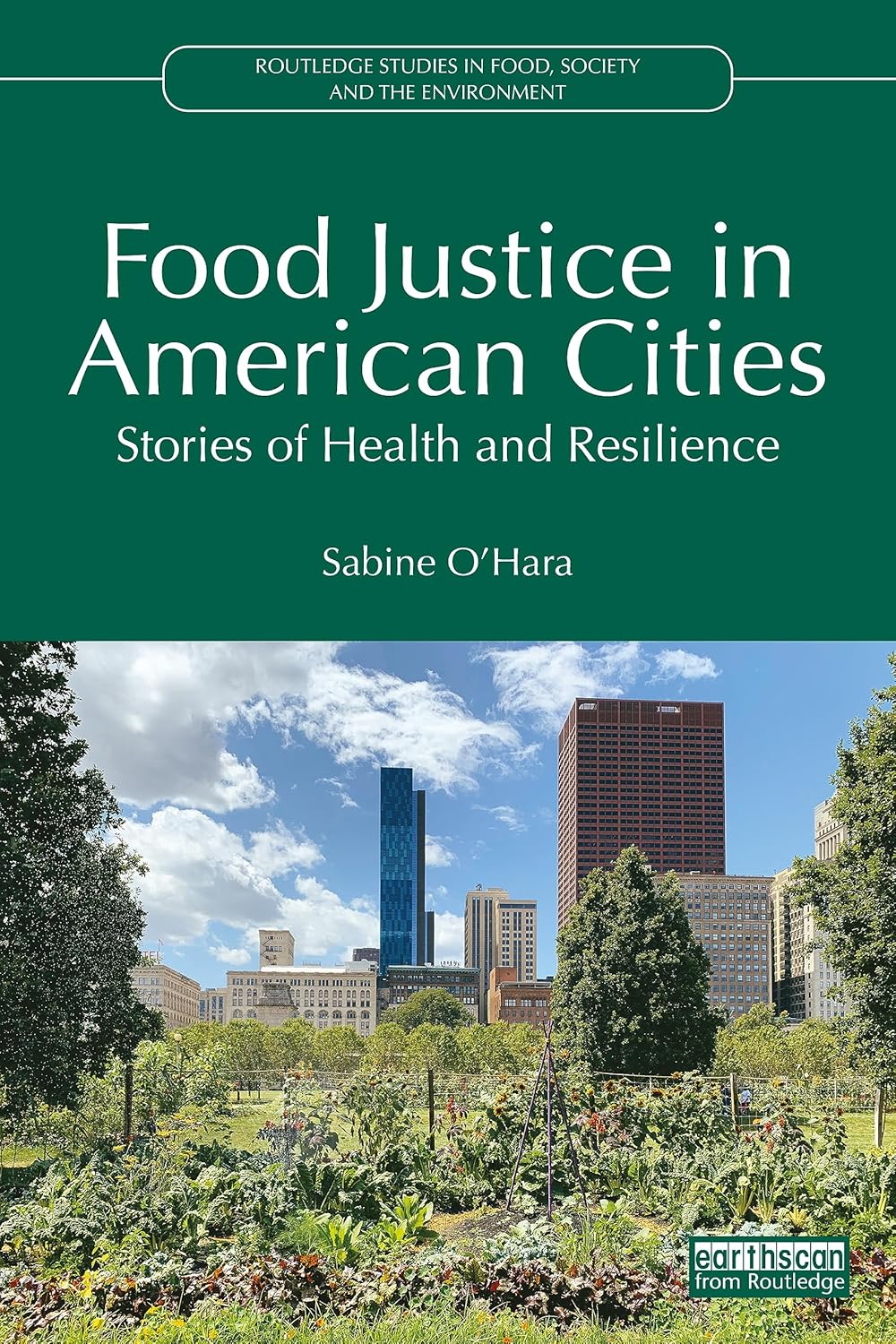
As a food systems researcher who teaches about the intersections of food, health, and environmental justice, I often find myself searching for materials that balance quantitative data with the qualitative lived realities of those the data represent. Sabine O’Hara’s Food Justice in American Cities: Stories of Health and Resilience (2024) is a prime example. Throughout the seven chapters, O’Hara draws on case studies in five cities—Chicago, Albuquerque, Atlanta, Oakland, and the Brooklyn borough of New York City—to describe how food insecurity affects the lives of urban residents and how the structural inequities that underlie food insecurity relate to history, policy, and place.
In the first few chapters, O’Hara sets the stage by providing background and current context for each city. This context situates readers to each city’s history and demographics, providing a foundation for understanding the challenges residents face. In subsequent chapters, we return to each city to hear powerful stories from individuals experiencing food insecurity and those working to improve food justice in each context. Many of the stories connect with current events and policies. For example, we hear from a 56-year-old immigrant in Oakland who stopped teaching to care for her mother. The two struggle to pay for food among the mounting rent, utilities, and medical bills. Her story underscores how SNAP work requirements—policies mandating 80 hours of work or training each month for able-bodied adults without dependents—can unfairly penalize care workers and those who do not fit the conventional definitions of “dependent” (U.S. Department of Agriculture [USDA] Food and Nutrition Service, 2025). . . .
Metrics
Downloads
Published
How to Cite
Issue
Section
Categories
License
Copyright (c) 2025 Kaitlyn Harper

This work is licensed under a Creative Commons Attribution 4.0 International License.
The copyright to all content published in JAFSCD belongs to the author(s). It is licensed as CC BY 4.0. This license determines how you may reprint, copy, distribute, or otherwise share JAFSCD content.