A political dissection of agrarian development in developing countries: A case from Bangladesh
DOI:
https://doi.org/10.5304/jafscd.2026.152.022
Keywords:
agricultural productivity, Bangladesh, agrarian transition, political economyAbstract
First paragraph:
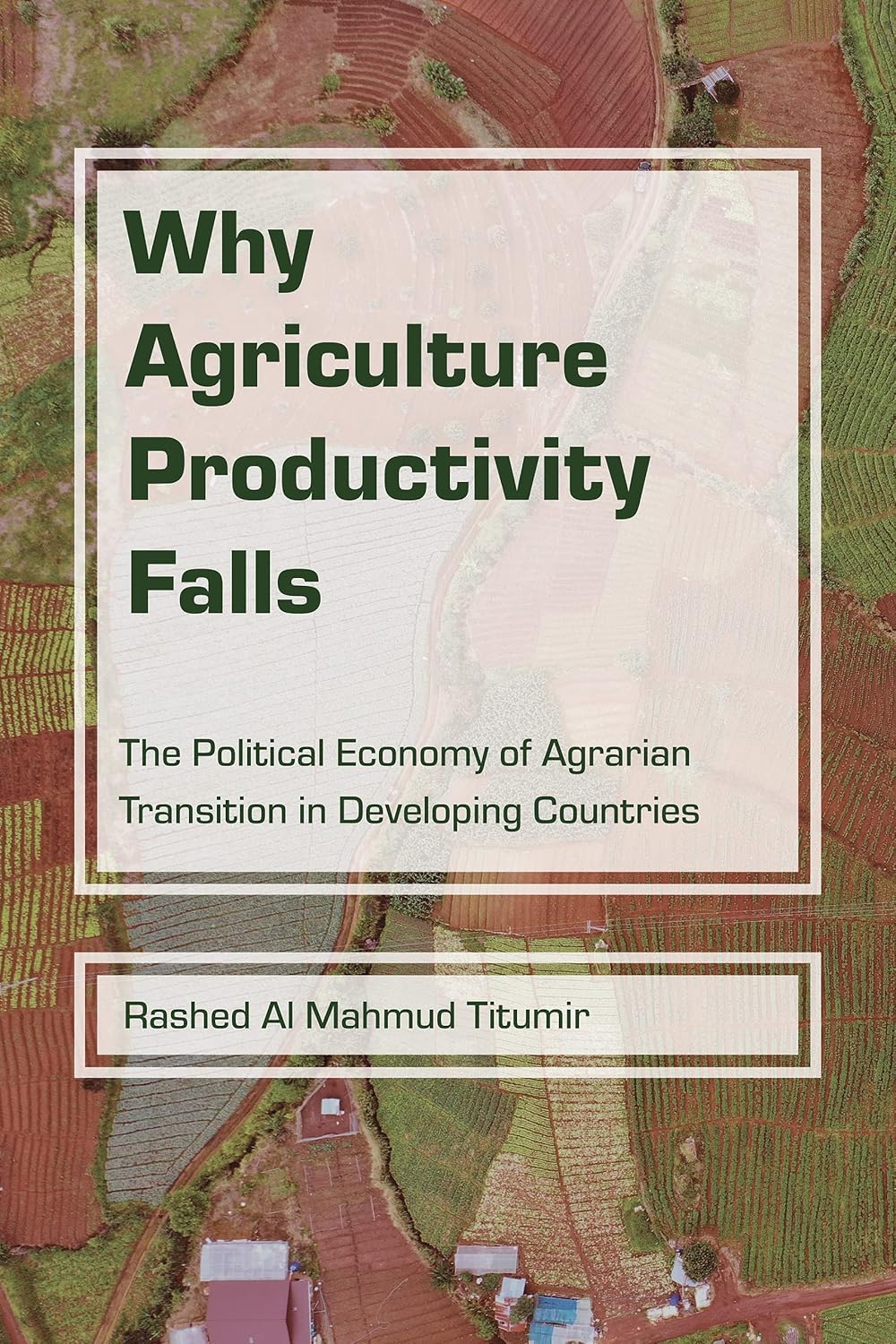
Rashed Al Mahmud Titumir’s Why Agriculture Productivity Falls: The Political Economy of Agrarian Transition in Developing Countries raises a profound question: why has agricultural productivity in many developing countries slowed or stagnated despite decades of Green Revolution technologies and neoliberal globalization? The author’s central claim is that productivity in developing countries is shaped less by factor endowments and “efficient” markets than by social property relations, political settlements, and non-market accumulation. Taking Bangladesh as the empirical case, the book shows how smallholder‑ dominated agrarian structures experience short‑run output growth when capital‑biased technologies and clientelist institutions prevail, but are locked into long‑run stagnation and environmental degradation. The argument moves between neoclassical, Marxist, and neopopulist perspectives. On the one hand, Titumir engages neoclassical and new institutional economics, which stress market (re-)allocation, property‑rights reform, and (supposedly) scale‑neutral technology. On the other, he draws heavily on Marx, Brenner, Wood, and political‑settlement theory[1] to foreground class power, “politically constituted property,” and nonmarket processes. He explicitly distinguishes between market accumulation and non-market accumulation (primitive accumulation), arguing that “there are at least two dimensions of nonmarket processes[:] … primitive accumulation and the operation of the political settlement” (p. 26). These are not residual complications to an otherwise well‑functioning market order. They are, in fact, the main drivers of land misallocation, disinvestment, and, ultimately, productivity decline. . . .
[1] A political settlement theory underscores that the distribution of power among elites and social groups shapes the formal and informal “rules of the game” and institutionalization in rural and agrarian settings (Gray 2019). Titumir uses this theory to explain that productivity decline in countries like Bangladesh is not solely technical but also a consequence of political settlements and institutional arrangements that favor factions, which benefit at the expense of productivity growth in the short run.
Metrics
Downloads
Published
How to Cite
Issue
Section
Categories
License
Copyright (c) 2026 Manoj Sharma

This work is licensed under a Creative Commons Attribution 4.0 International License.
The copyright to all content published in JAFSCD belongs to the author(s). It is licensed as CC BY 4.0. This license determines how you may reprint, copy, distribute, or otherwise share JAFSCD content.