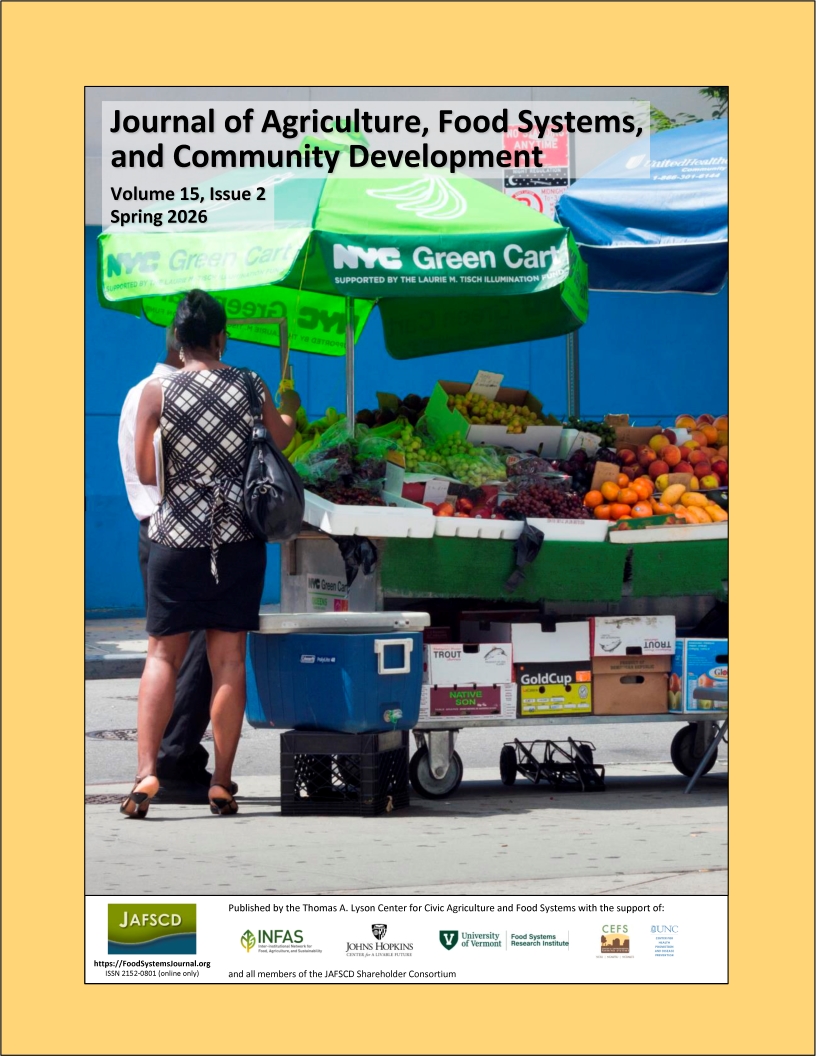
Sustaining mobile produce vending in NYC: Evaluating the future of Green Carts
DOI:
https://doi.org/10.5304/jafscd.2026.152.010
Keywords:
food access, mobile food vending, Green Carts, public health, food policy, New York CityAbstract
Consumption of fresh fruits and vegetables is essential for preventing diet-related chronic diseases, yet many low-income residents have inadequate diets because their communities face persistent barriers to supplying healthy food. In New York City (NYC), the Green Carts program is a mobile produce vending initiative to improve fresh food access in underserved neighborhoods while supporting immigrant entrepreneurship. This paper presents the findings of a multi-methods evaluation of the Green Carts program and points to a fundamental tension between the program’s public health goals and vendors’ financial viability. We found that Green Carts are an important source of produce for the more than half of customers who buy from them multiple times per week, but vendors earn a median annual income of $20,000,[1] substantially below NYC’s living wage. Low electronic benefit transfer (EBT)[2] acceptance limited accessibility for Supplemental Nutrition Assistance Program (SNAP) recipients, and more than half of NYC’s public housing developments, home to more than 400,000 low income residents, lack convenient access to Green Carts. Mobile produce vending can meaningfully address urban food inequities, but current economic constraints limit the program’s sustainability and impact. We suggest several improvements to help realize its potential, including financial support for vendors, expanded EBT access, and location incentives aligned with equity goals. This program evaluation provides practical insights for other cities seeking to implement mobile vending models to improve public health and provide economic opportunities for local vendors.
[1] All currency in this report is in US$.
[2] Electronic benefits transfer (EBT) is the electronic system used to accept SNAP payments.
Metrics
Downloads
Published
How to Cite
Issue
Section
License
Copyright (c) 2026 Katherine Tomaino Fraser, Rositsa T. Ilieva, Jacquelyn Sullivan, Julia Greene, Mukta Mohnani, Craig Willingham, Nevin Cohen

This work is licensed under a Creative Commons Attribution 4.0 International License.
The copyright to all content published in JAFSCD belongs to the author(s). It is licensed as CC BY 4.0. This license determines how you may reprint, copy, distribute, or otherwise share JAFSCD content.